From the Naturalis Herbal journal archive. Updated for this site in November 2026. Current ingredients, prices, stock, and ordering options are listed in the Naturalis Herbal shop.
“There’s rosemary, that’s for remembrance.”
Long before Shakespeare wrote those famous words, rosemary had already earned a place in traditional herbal practices as a plant associated with memory, clarity, and mental alertness. Today, researchers are studying rosemary to better understand how its naturally occurring compounds may affect the brain.
Rosemary, now botanically known as Salvia rosmarinus and formerly called Rosmarinus officinalis, is much more than a seasoning. Its leaves contain antioxidants, aromatic oils, and plant compounds that may help protect brain cells from oxidative stress and inflammation.
Although rosemary cannot cure dementia, Alzheimer’s disease, Parkinson’s disease, or another neurological condition, early research suggests that it may offer gentle support for memory, concentration, and overall brain health.
Why Rosemary Is Being Studied for Brain Health
The brain uses a tremendous amount of oxygen and energy. This makes brain cells especially vulnerable to oxidative stress, which occurs when unstable molecules called free radicals overwhelm the body’s natural defenses.
Oxidative stress and chronic inflammation are associated with aging and several neurological conditions, including Alzheimer’s disease and Parkinson’s disease. Rosemary contains compounds that demonstrate antioxidant, anti-inflammatory, and neuroprotective activity in laboratory and animal research.
“Neuroprotective” simply means that a substance may help protect nerve cells from damage. This does not automatically mean the substance can prevent or treat a neurological disease, but it gives researchers an important reason to continue studying it.
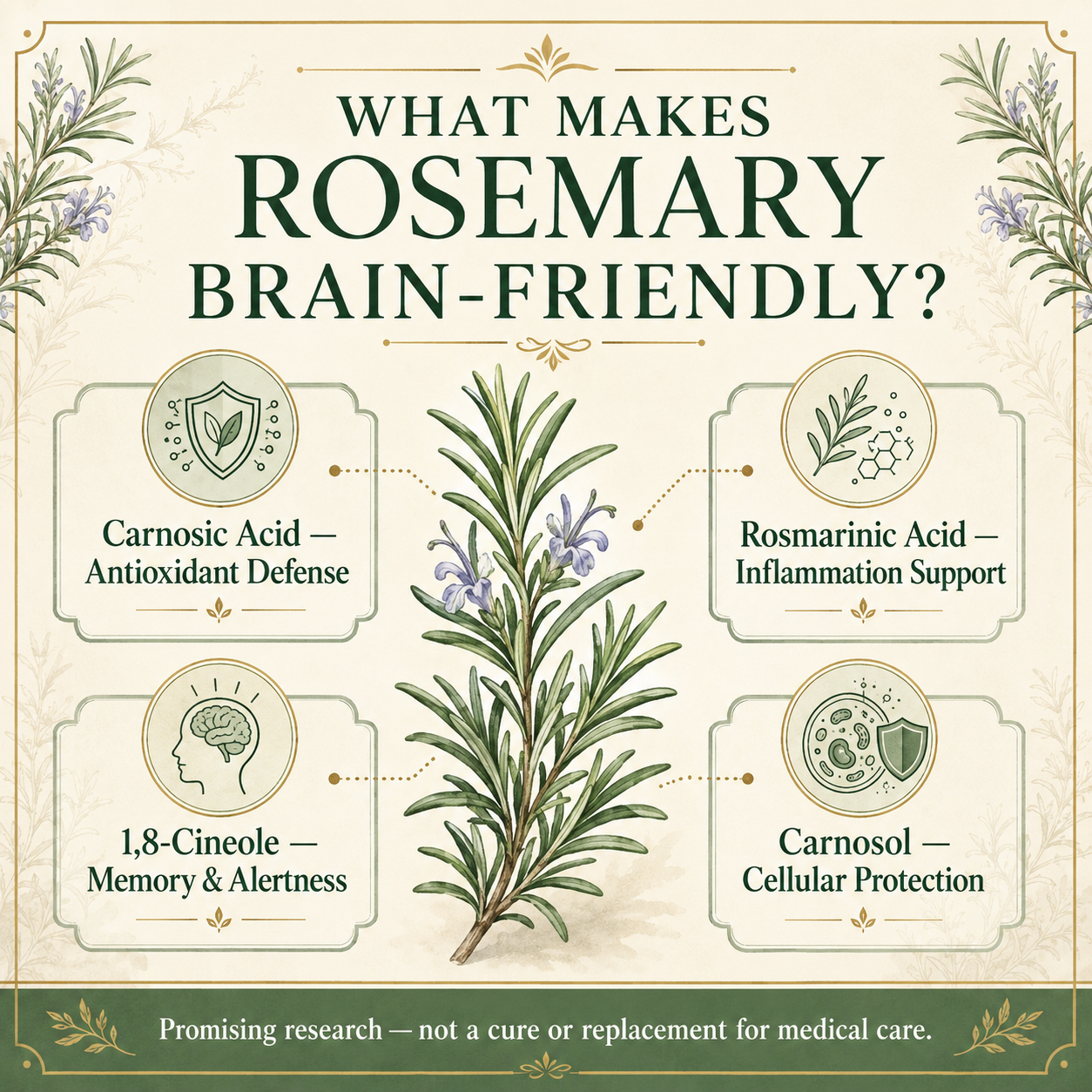
Rosemary’s Most Important Brain-Supporting Compounds
Rosemary does not depend on one single ingredient. It contains several active compounds that may work together.
Carnosic Acid
Carnosic acid is one of rosemary’s most closely studied compounds. It appears to activate the body’s Nrf2 pathway, sometimes described as a cellular antioxidant defense system. Activating this pathway may help cells respond to oxidative stress and inflammation.
In laboratory and animal studies, carnosic acid has
been investigated for its possible effects on:
-
Inflammation in the brain
-
Oxidative damage
-
Amyloid-beta accumulation
-
Abnormal tau proteins
-
Communication between nerve cells
-
Memory and learning
Amyloid-beta plaques and abnormal tau proteins are two major features associated with Alzheimer’s disease. Researchers have developed a more stable compound derived from carnosic acid that produced encouraging results in an Alzheimer’s mouse model. However, this experimental drug is not the same as drinking rosemary tea, and human clinical trials are still needed. Scripps Research
Rosmarinic Acid
Rosmarinic acid is a powerful polyphenol found in rosemary, lemon balm, sage, and several other members of the mint family.
Research suggests that rosmarinic acid may:
-
Help neutralize damaging free radicals
-
Influence inflammatory processes
-
Protect nerve cells under experimental conditions
-
Interfere with the formation or aggregation of certain abnormal proteins
Laboratory and animal findings have generated interest in rosmarinic acid for Alzheimer’s disease and other neurological conditions. The evidence remains preliminary, however, and researchers have not established rosemary tea or rosmarinic acid as a treatment for dementia.
1,8-Cineole
The fresh, penetrating scent of rosemary comes partly from 1,8-cineole, also called eucalyptol. This aromatic compound is especially noticeable when rosemary leaves are crushed or rosemary essential oil is inhaled.
In one small human study, researchers detected 1,8-cineole in participants’ blood after they inhaled rosemary aroma. Higher levels were associated with better performance on certain cognitive tasks. This suggests that rosemary’s aroma may influence mental processing, although the study was small and did not involve people with dementia. Published study
Laboratory research also suggests that 1,8-cineole may inhibit acetylcholinesterase, an enzyme that breaks down acetylcholine. Acetylcholine is an important neurotransmitter involved in memory, attention, and learning. Some prescription Alzheimer’s medications also affect acetylcholine, but rosemary should never be considered a replacement for those medicines.
Carnosol
Carnosol is related to carnosic acid and contributes to rosemary’s antioxidant and anti-inflammatory properties. Researchers are examining how these compounds may help regulate cellular stress responses and protect tissues from oxidative damage.
Ursolic Acid and Other Plant Compounds
Rosemary also contains ursolic acid, caffeic acid, flavonoids, and additional terpenes. These compounds may contribute to its overall antioxidant and anti-inflammatory activity. Researchers believe rosemary’s effects may come from the interaction of many compounds rather than from one isolated ingredient.
What Human Research Actually Shows
A small randomized, double-blind study examined the short-term effects of dried rosemary leaf powder in 28 older adults. A 750-milligram culinary-size dose was associated with an improvement in one measure of memory speed. A much larger dose did not produce the same benefit and negatively affected some cognitive measurements. This is an important reminder that more is not always better with herbs. PubMed study
Other small studies have examined rosemary aroma and cognitive performance in healthy adults. Some results suggest possible improvements in memory speed, alertness, or task performance, but these studies do not prove that rosemary slows Alzheimer’s disease or treats dementia.
Most of the research involving amyloid plaques, tau proteins, Parkinson’s disease, epilepsy, or direct protection of brain cells has been conducted in cells or animals. These findings are promising, but they cannot automatically be applied to people.
Rosemary and Dementia or Alzheimer’s Disease
For someone living with dementia or Alzheimer’s disease, rosemary may be considered a supportive food or comforting wellness ritual, provided their healthcare professional considers it appropriate.
A warm cup of rosemary tea may provide:
-
A familiar sensory experience
-
Hydration
-
A pleasant daily routine
-
An uplifting aroma
-
Gentle antioxidant plant compounds
-
A possible short-term feeling of mental freshness or alertness
Rosemary should not be presented as a cure or a substitute for medical evaluation, prescribed medication, occupational therapy, adequate nutrition, sleep, movement, or caregiver support.
Memory changes can also be caused by medication side effects, infections, sleep disorders, vitamin deficiencies, depression, thyroid problems, and other treatable conditions. New or rapidly worsening confusion should always be evaluated by a medical professional.
What About Other Neurological Conditions?
Researchers are investigating rosemary and its compounds in connection with Parkinson’s disease, anxiety, depression, epilepsy, pain, stroke-related damage, and other nervous-system conditions. Much of this work remains preclinical.
Rosemary’s antioxidant and anti-inflammatory properties may be relevant to several neurological conditions, but that does not mean it has been proven to treat them. Each condition has different causes, risks, and treatment needs.
People with epilepsy or a history of seizures should be particularly careful with concentrated rosemary essential oil. Essential oils are highly concentrated and are very different from culinary rosemary or a mild tea.
Simple Rosemary Tea
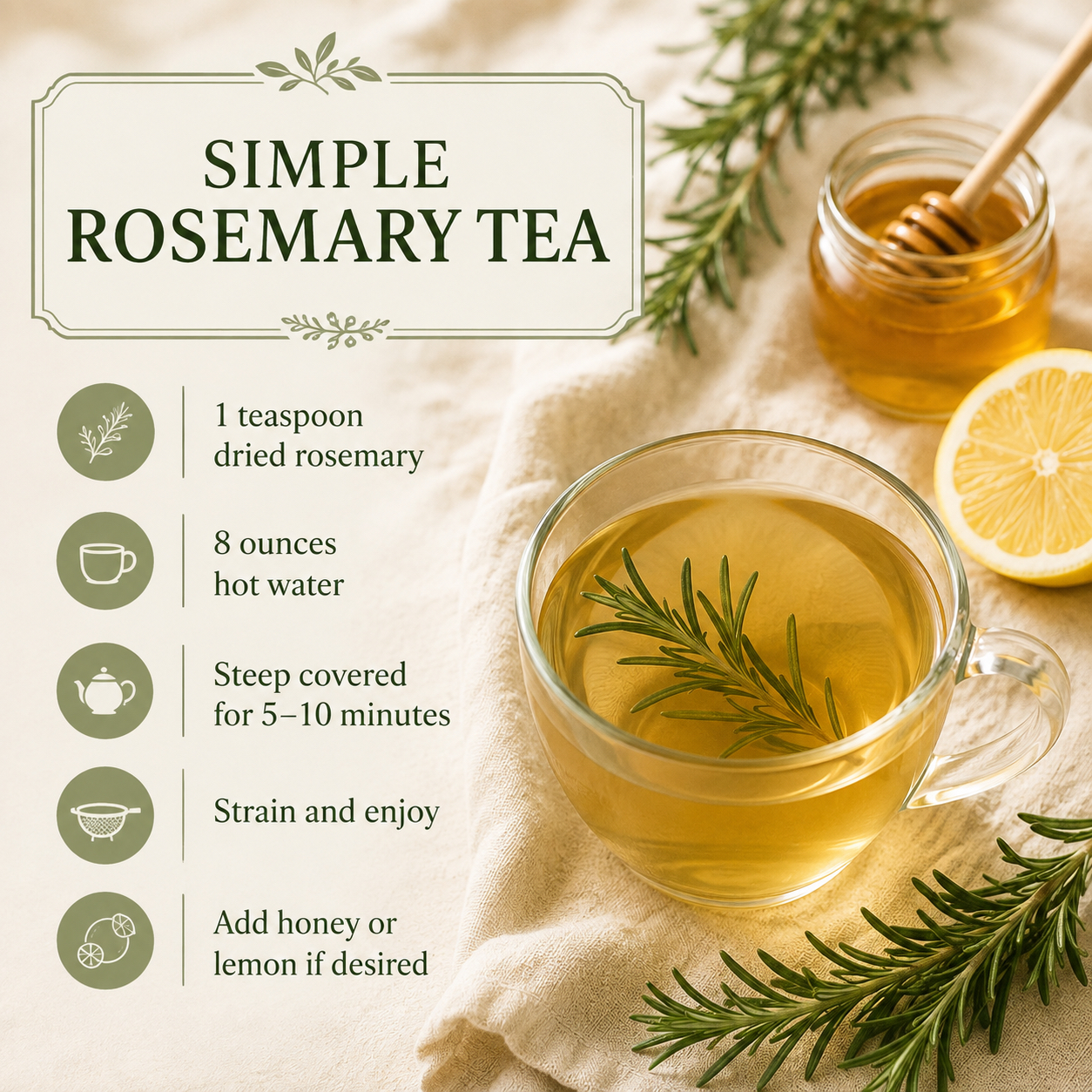
Ingredients
-
1 teaspoon dried rosemary leaves or 1 small fresh rosemary sprig
-
8 ounces of hot water
-
Honey or lemon, if desired
Directions
-
Place the rosemary in a mug or tea infuser.
-
Pour the hot water over the rosemary.
-
Cover the mug to help keep the aromatic compounds from escaping.
-
Steep for 5 to 10 minutes.
-
Strain the tea.
-
Add a small amount of honey or lemon if desired.
Rosemary has a bold, pine-like flavor, so start with a weaker tea and adjust it to your preference. One mild cup is a reasonable place to begin for most adults who can safely consume rosemary.
For a softer flavor, rosemary may also be blended with lemon balm or a slice of fresh lemon.
Important Safety Information
Rosemary used in normal culinary amounts is generally well tolerated, but concentrated extracts, supplements, and essential oils are not the same as food or tea.
Keep these precautions in mind:
-
Never swallow rosemary essential oil.
-
Do not add essential oil directly to tea or drinking water.
-
Ask a healthcare professional before using medicinal amounts during pregnancy or breastfeeding.
-
Speak with a healthcare professional before regular use if you have epilepsy, a seizure disorder, serious kidney or liver disease, or take multiple medications.
-
Check with a pharmacist or physician if you use blood thinners, blood-pressure medicine, diabetes medicine, diuretics, or neurological medications.
-
Stop using rosemary if it causes an allergic reaction, stomach irritation, dizziness, or another unusual symptom.
-
Caregivers should make sure tea is served at a safe temperature and that the person can swallow liquids safely.
The Bottom Line
Rosemary deserves its long-standing reputation as the herb of remembrance. It contains carnosic acid, rosmarinic acid, 1,8-cineole, carnosol, and other compounds that have demonstrated antioxidant, anti-inflammatory, and neuroprotective properties in early research.
Small human studies suggest rosemary may temporarily support certain aspects of memory or cognitive performance. Laboratory and animal research also offers intriguing clues about how rosemary compounds could affect inflammation, oxidative stress, amyloid-beta, and tau.
Still, rosemary has not been proven to prevent, reverse, or cure dementia, Alzheimer’s disease, Parkinson’s disease, or another neurological condition. Think of it as a nourishing herb and a possible part of a brain-supportive lifestyle—not as a replacement for medical care.
Sometimes supporting wellness begins with something simple: a familiar aroma, a quiet moment, and a warm cup of tea.
This article is for educational purposes only. It is not intended to diagnose, treat, cure, or prevent any disease. Always consult a qualified healthcare professional before using herbs medicinally, particularly when neurological conditions or prescription medications are involved.
This journal is for general education and personal reflection. Traditional uses and individual experiences are not proof of effectiveness. Products are not substitutes for medical diagnosis or treatment. Ask a qualified healthcare professional about individual suitability and medicine interactions.